sigvault

Bitcoin custody for more than one person.

Multisig signing, coordinated across people, devices, and organizations — and we never touch a key.

Read the threat model
Open sourceSelf-hostable
ceremony · openescrow.policy · 2-of-3 · three organizations
signer · 01 · buyersigning
acme ltd
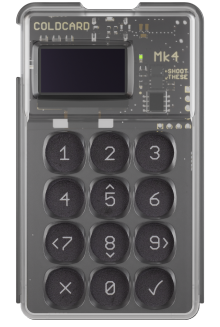
coldcard · 6fb270de
signer · 02 · sellerawaiting
borden & co
bitbox02 · 35858ac5
signer · 03 · arbiterawaiting
j. reyes
jade · 14d0c2f8
collecting signatures0 / 3 signatures
Live on testnet & signet

Mainnet is not open yet. SigVault is young software that will handle real money. We publish our threat model, our trust boundaries, and our limitations — read them before you deposit.

01The two surfaces

One coordinates.
The other signs.

The split is the whole security argument: the thing on the internet holds no keys, and the thing holding the keys never talks to us.

regtest.sigvault.org/wallets/new
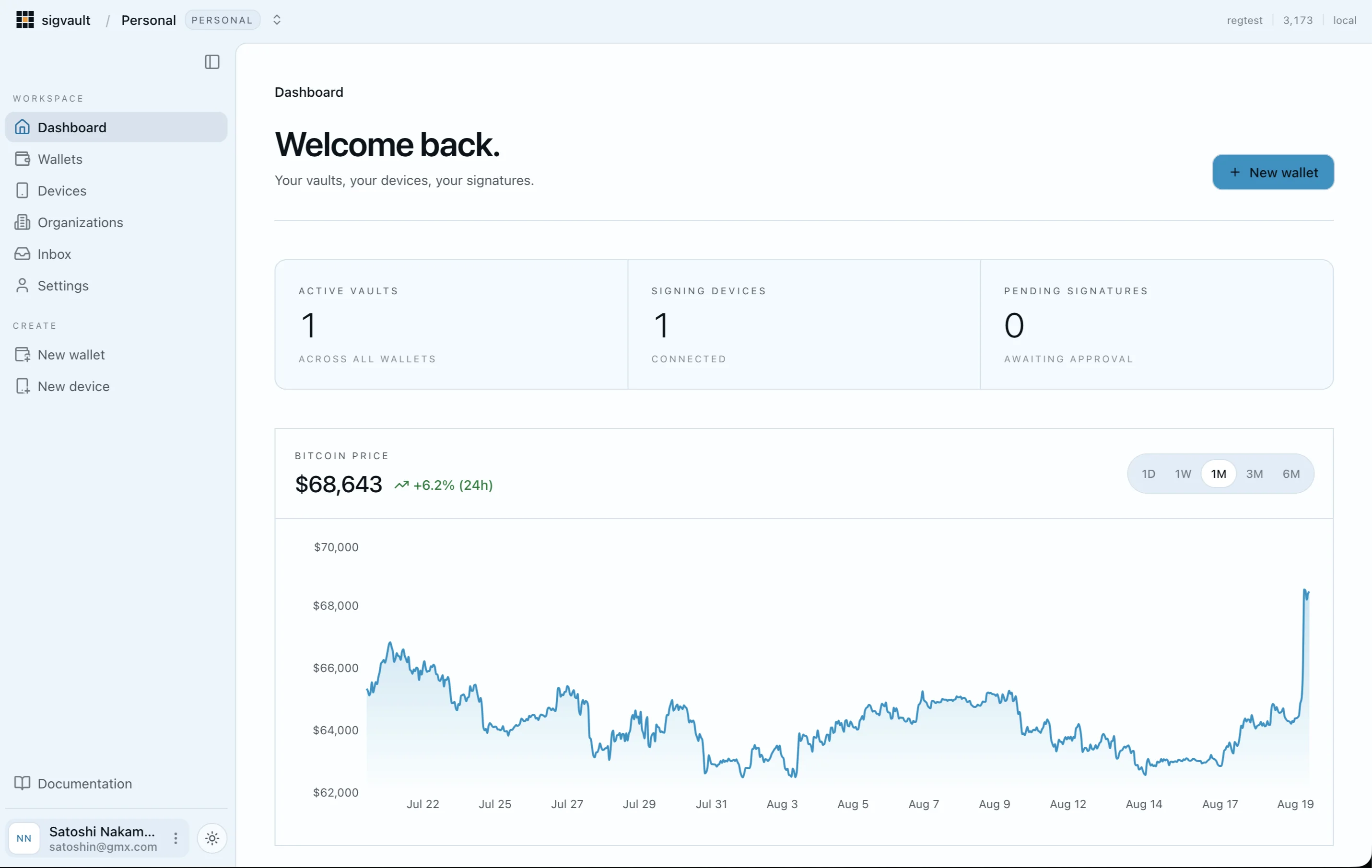
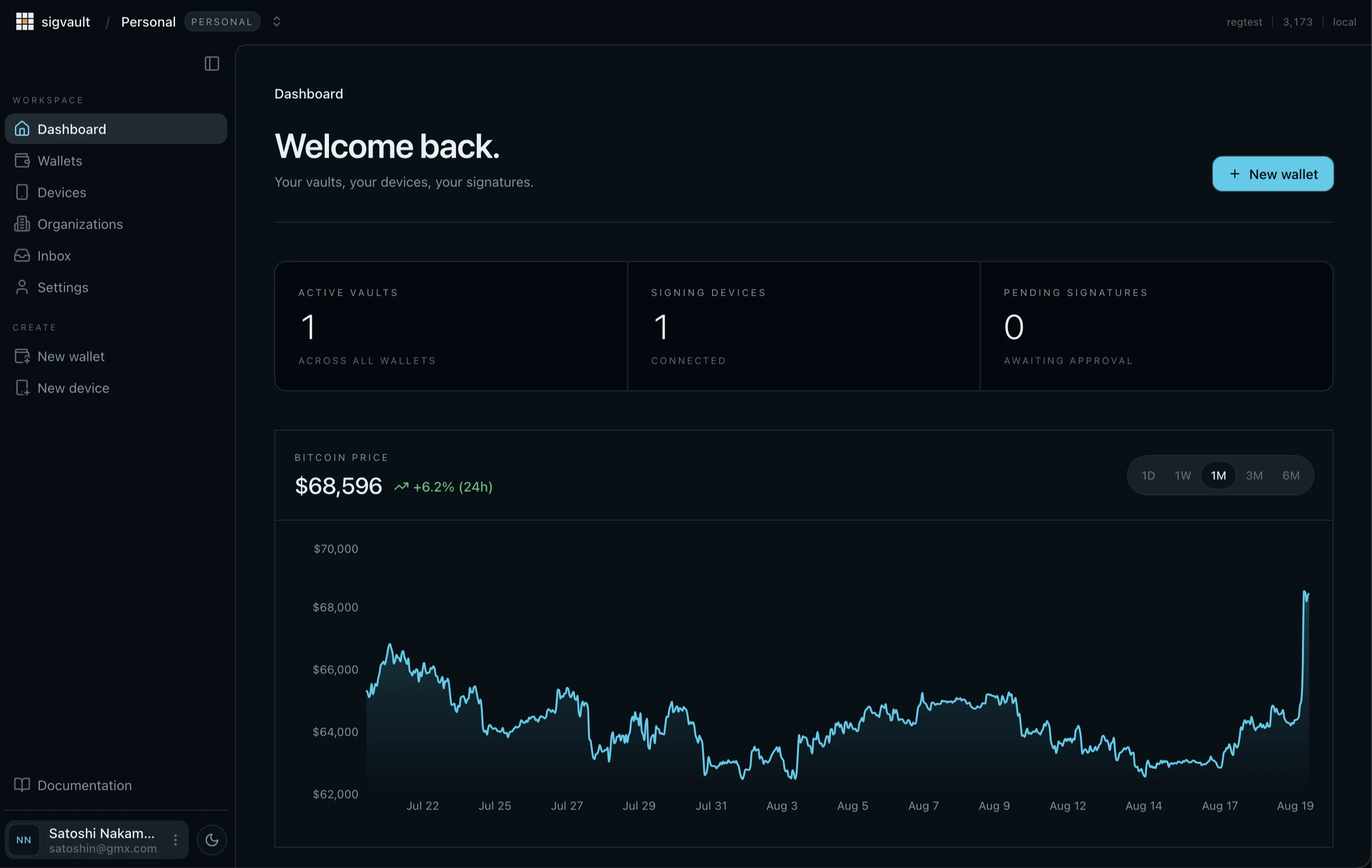
SigVault dashboard — building a wallet's spending policy
SigVault desktop signer
In the browser

The coordinator

Policy, ceremony state, and a signed audit trail. It sees PSBTs and policy. It never sees a key.

On your machine

The signer

The open-source desktop app talks to your hardware wallet. Every transaction is confirmed on the device's own screen.

02The ceremony
  1. step · 01
    01

    Build the policy

    Choose a quorum — 2-of-3, 3-of-5, or a Taproot policy with time-locked recovery paths. Signers can come from inside your organization or from a counterparty's. Nobody has to join anyone else's workspace.

  2. step · 02
    02

    Everyone brings their own key

    Each signer runs the open-source desktop app with their own hardware wallet. Keys are generated on the device and never leave it. SigVault never sees key material.

  3. step · 03
    03

    Sign the ceremony

    A session opens. Each signer reviews the transaction on their own device screen and approves. Partial signatures relay through the coordinator. When the threshold is met, the transaction broadcasts.

  4. step · 04
    04

    Everyone keeps their own record

    Each organization gets its own signed, exportable audit trail. Nothing is commingled.

03What we claim

Four claims, each of which
a stranger can verify.

In Bitcoin custody, a claim you can't prove costs more than a feature you don't have. Every line below links to the evidence.

01

Built for quorums that cross organizations

Most custody products assume one account holder. SigVault assumes several parties who each need their own workspace, their own roles, and their own records — and who still need to sign together. A buyer, a seller, and an arbiter. Four founders. Five DAO delegates from five organizations.

See how organizations work
02

The coordinator can't move your money

Signatures are produced on hardware wallets. SigVault relays PSBTs, policy, and ceremony state — never private keys. A complete shutdown of SigVault would not put a single satoshi at risk, and our threat model spells out exactly why.

Read the threat model
03

Run it yourself

Pair your own instance of the wallet service and bind your vaults and devices to it. Your traffic goes through your hardware, on your network, behind your IP allow-list. Most people won't. The ones who do validate the architecture for everyone else.

Self-hosting guide
04

Recoverable without us

Vaults are built on output descriptors, BIP-388, and Miniscript. Your funds are recoverable in Sparrow or any descriptor-capable wallet without SigVault's cooperation or existence. Time-locked recovery paths execute on the Bitcoin network whether or not this company is still here.

How recovery works
04The custody question

Non-custodial by default —
and we'll always tell you when it isn't.

Casa and Unchained both hold a key, and it hasn't hurt them, because they say so. The sin is never holding a key. It's claiming you don't.

Standard vault · the default

Every key is yours

  • Each key is generated on your own hardware wallet and never leaves it.
  • We cannot sign, cannot move funds, and cannot reconstruct your keys.
  • A total compromise of SigVault does not put a satoshi at risk.
Optional · you choose this

One key is ours, and labelled ours

  • You may add a SigVault-held key as one signer — useful for recovery or policy enforcement.
  • It is labelled as ours everywhere it appears, in the UI and in the descriptor.
  • It counts as one signature and no more. It can never reach your threshold alone.

Set your quorum so that our key is never decisive. If you run 2-of-3 with one SigVault key, we plus one compromised signer could move funds. That is a real consideration and you should design around it. We'd rather say so. That's the whole story.

Here's the threat model
Collaboration

Multisig with people,
not just keys.

Organizations let teams, families, and institutions hold a vault together — and keys can come from members of different organizations, without merging anyone's workspace or audit trail.

Trust Model

Three layers of opt-in
before a key joins a vault.

Sharing a device gives an org visibility into a public key — not authority to spend. Every layer is revocable in one click.

join the org · grants role + grants

  1. layer · 01
    01

    Join the org

    Accept an invite to become a member with a defined role and a per-permission grant set.

  2. layer · 02
    02

    Share a device

    Opt in to expose a hardware device's public key to the org's vault builder. Revocable anytime.

  3. layer · 03
    03

    Approve each vault

    Explicitly consent to your key joining each specific multisig. Per-vault, never blanket.

SigVault never holds keys, signs on a member's behalf, or auto-includes a device in a vault. The org is a coordination layer, not a custodian.

05Signing devices

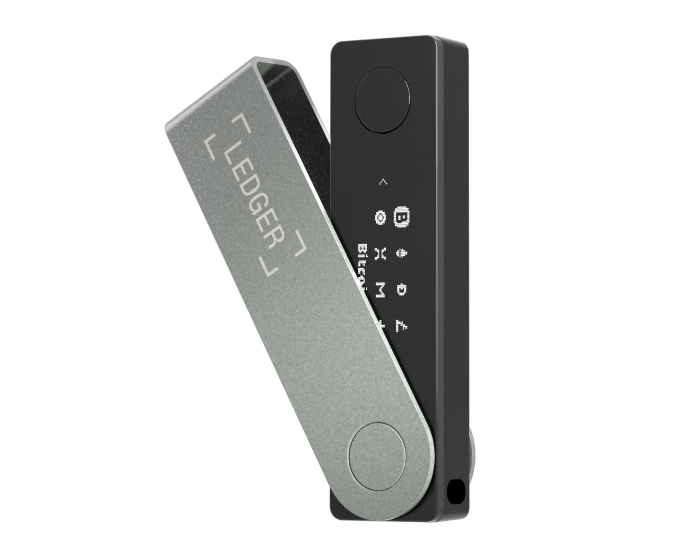
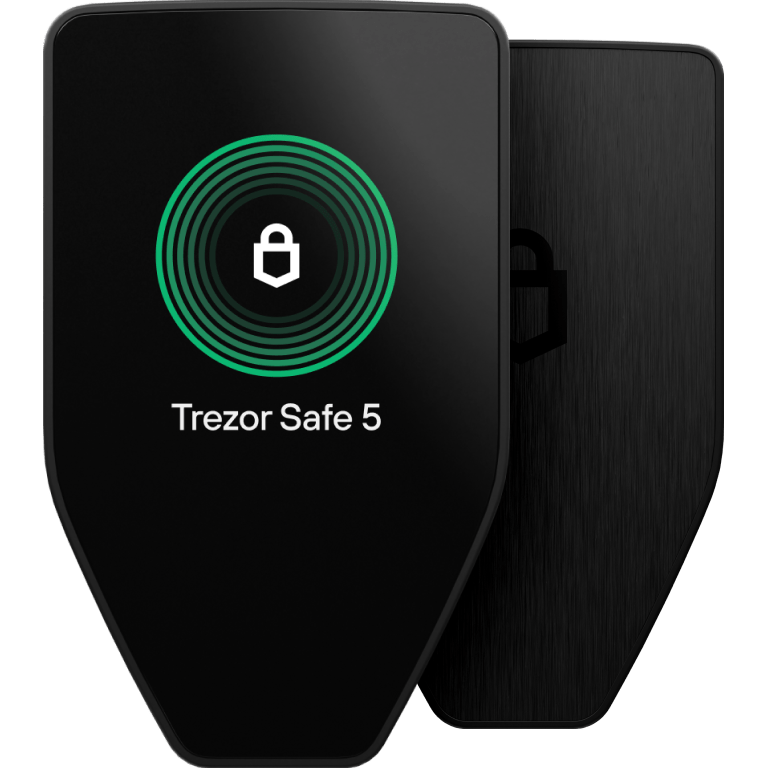
Bring the device
you already trust.

A quorum doesn't require everyone to agree on a vendor. Each signer uses whatever they already own — which matters when the keys belong to four people at three companies.

6fb270de
Ledger
Ledgernative
35858ac5
Jade
Jadenative
14d0c2f8
BitBox02
BitBox02native
455537ce
Trezor
Trezornative
a1b9f4e2
Coldcard
Coldcardnative
c30d81b7
diy
Specter DIYnative

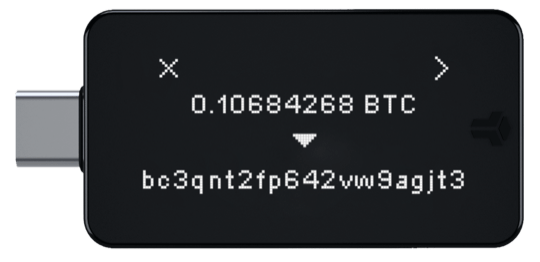
Always verify on the device screen, never in a browser. Bybit lost $1.46 billion because approvers trusted an interface instead of their hardware. That applies with us and with anyone else.

06Why coordination

Multisig doesn't fail.
Coordination does.

Five incidents from the last eighteen months. Not one of them was a cryptographic failure.

Bybit

Feb 2025
$1.46B

The signing interface lied to the people approving the transaction. The multisig math was correct.

Coinbase

May 2025
~$400M

Insider access at a support contractor turned a customer database into a target list.

Zondacrypto

Dec 2025
4,500 BTC

The founder disappeared holding the only keys. The coins are still stranded.

AscendEX

Jul 2026
7 figures

Hot-wallet operations ran out of funds to honour withdrawals. Not cryptography — bookkeeping.

Ctrl Wallet

Jun 2026
~650k users

A self-custodial vendor shut down after an exploit and took its users' access with it.

Every one of them happened in the layer around the keys — the interface, the operator, the humans, the company's continued existence. That layer is where the money actually goes missing, and it is almost never the part anyone audits.

SigVault is that layer. So we built it to be checked rather than trusted.

07Evidence

No logo bar. No testimonials.
Artifacts you can check.

This audience checks, and getting caught is unrecoverable. So here is only what exists — and plainly, what doesn't yet.

available

Open-source signer

The desktop signer is BSD-3 licensed. Read the code that touches your keys.

Read it on GitHub
available

Published threat model

What our servers can see, what an attacker who owned them could do, and what we don't protect against.

Read the threat model
not yet

Reproducible builds

Verify that the binary you're running matches the published source, byte for byte.

we'll link it here when it's real
not yet

Independent security audit

No third-party audit has been completed. One is being scoped. When it lands we publish the full report — findings included, not a summary.

we'll link it here when it's real

We have not had a security incident. We have also not yet had enough users or enough time for that to mean very much, and we'd rather say so than imply a track record we haven't earned.

Begin

Start with a vault that doesn't matter yet.

Create a free vault on signet, connect the hardware wallet you already own, and run a signing ceremony with someone you trust. Ten minutes. No card.

open-source signerverifiable coordinationrecoverable without us